How I tried and succeeded at my first Inktober
After telling myself for years that I didn't have time for Inktober, I decided this was the year I was going to give it a go. You can see the whole progression my Instagram account:
https://www.instagram.com/chipcullen/
What is Inktober?
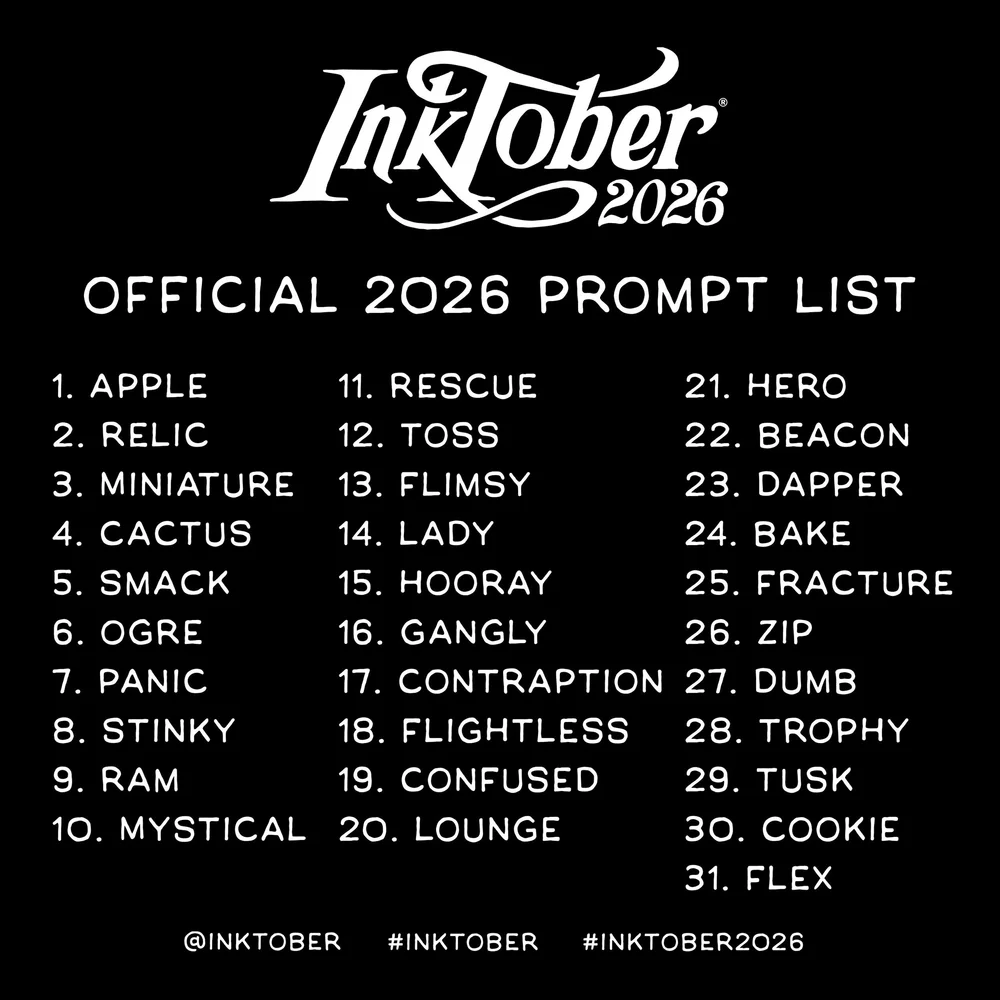
If you've not heard of Inktober, it's a month-long drawing challenge that happens every year. A list of prompts are released, and the challenge is to come up with art and post it every day for the entire month.
Why now?
No idea, really. I just felt like I had avoided it for so long, and I needed to confront it.
How did it go?
I did it. The whole thing. On my first attempt.
Apparently this is not common. I have one work colleague, who is a professional artist outside of work, who said he had never know anyone who actually had done the whole thing.
What was my secret?
It's going to sound boring - I had a clear objective in mind, and a strategy. I cut down on as many decisions as I could along the way so that actually making the art was as straightforward as possible.
What was my objective?
I think this was the biggest thing for me. I had a clear "why". My objective was to use Inktober as a way to force me to use digital drawing tools in order to get more familiar with drawing digitally.
Background: despite working with tech my whole career, when it comes to art, I've been an analogue die hard. My favorite mediums are water color and ink - on paper. IRL. I had never liked drawing with a computer stylus on a screen - I had always preferred the feel of a brush or pen on actual paper.
I had recently become interested in trying out drawing digitally, despite negative reactions to it in the past. There are some inherent advantages that simply cannot be ignored. I had an old iPad (with a first gen Apple Pencil) that I started with, and midway through got a more up to date iPad (and the Apple Pencil Pro).
What was my strategy?
I looked at the list of prompts and quickly came to some decisions. I would:
- Use Procreate on the iPad, with the Apple Pencil (and later, Pro).
- Create a comic with all the pieces. Each day's piece would usually be one panel, but they would string together to tell a story. That made the story sort of a 'improv game' where I had to make one panel make sense with the previous one and lead into the next.
- Keep the same format and style the entire time. This cut down considerably on the decisions I would need to make each day.
- No AI - at all. For anything.
So, how did I do it?
Tactically, I treated the whole thing like a project - an illustration gig, if you will. For one thing, I was thinking through all of this stuff in the middle of September - weeks before the 'challenge' began.
I started coming up with character sketches, just so I had something to start with. If you go through my posts, the 'little witch' is based on some early sketches I did - weeks ahead of time.
I came up with the 'template' that was used for the panels each day. That had the format settled - I just needed to draw within it.
Finally, I started coming up with pencil 'roughs' for each day of the challenge. This is where the hard 'thinking' was done. I came up with ideas based on each prompt in order to tie the story together. By the time October 1st came around, I had roughs done for about half the month already. It was really just up to me to create finished, "ink" versions of the art and post them.
The roughs were drawn on layers built into the template. When doing the finished, inked artwork, those would be layers on top.
Time is a construct
I knew that I would never be able to wake up each day in October, look at the prompt for the day, and come up with a finished piece of art. Having that expectation would have been an invitation to failure.
My life does not work that way. I have more time and energy on some days than others. I just know that about myself, and worked with that, not against it.
The only goal, as far as I was concerned, was to post something every day. It didn't mean it had to be created that day.
As I said, by the time October 1st came around, I had half the ideas already roughed. I did start that day and made a finished piece of art, and posted it. But I then quickly started working 'ahead'. I would try to get one or two days ahead in terms of 'finished' pieces, but then any spare time I had would mean making more roughs.
By about October 10th, I had roughs done for the whole month. I knew where the story was going.
Bill Watterson (of Calvin and Hobbes fame) would work one long day and draw all of the strips for a month. That let him focus on writing for weeks at a time. He also worked 'ahead' several months, which gave him leeway to scrap material that wasn't working. I think these working methods are a big reason why that strip is so great.
As I got more and more ahead, I was able to relax and enjoy the drawing experience. I knew I had some forgiveness in my schedule. To be transparent - I did not draw every day. But I posted every day. (In truth, I got very comfortable with Instagram's 'scheduled post' feature.)
And, I was actually done with the challenge on October 24th - a full week ahead of time.
If you ain’t cheatin’, you ain’t tryin’
As I was learning to use digital tools for creating art - I set about trying to use those advantages as much as I could. This meant:
- Copying backgrounds, figures, etc, from one post to the next
- Scaling or moving elements when they weren't quite right
- Keeping things in layers so that they could be moved easily. For example - I had a background color layer, and a 'cloud' layer. I would copy both from one piece to the next, then move the clouds horizontally to give the impression of movement when read in sequence.
- Liberal use of 'undo'
- Going back to previously 'done' art and adjusting so that a later piece was easier
All of this meant that sometimes making a 'finished' piece only took 10 minutes. Others took two hours when there was nothing to copy from.
How do I think it went?
I did succeed at what I set out to do, so I feel good about that. While Inktober is a lot of work, it's not the insurmountable challenge that I built up in my head.
There are some stylistic choices that I wish I had made differently, or at least had made so that I had a little more leeway. The strict grayscale color scheme ended up being boring to work with. The 'flat' coloring also was limiting. I think I had reverted to an old cartoon style that I had used years ago, and didn't get past.
But the resulting pieces were at least consistent.
Did the story make sense? ... Kinda. It's very surreal. But that I'm okay with.
Did I have fun? Absolutely. But by the end I was also looking forward to a break.